
Using sEMG Biofeedback for Dyssynergic Defecation
A recent 2025 review in the Journal of Health Sciences recommends surface EMG (sEMG) biofeedback as a first-line treatment for functional defecation disorders.
It also found biofeedback works better than standard care and improves quality of life. Major organizations, including the American Neurogastroenterology and Motility Society and the American College of Gastroenterology, also support biofeedback as the first-line treatment for dyssynergic defecation.
What is Dyssynergic Defecation?
Dyssynergic defecation (pelvic floor dyssynergia) happens when the pelvic floor muscles don’t relax—or even contract—during a bowel movement. This leads to difficulty passing stool and chronic constipation. It’s a common diagnosis we see in pelvic floor therapy.
Why sEMG Biofeedback Works
sEMG biofeedback helps retrain muscle coordination. It uses sensors (external or internal) to show patients their pelvic floor activity in real time.
When patients try to have a bowel movement, they may:
- Hold their breath
- Bear down without relaxing the pelvic floor
- Tighten the anal sphincter instead of releasing
Biofeedback lets them see these patterns immediately and learn how to correct them with coaching. This supports motor learning and helps reset long-standing habits.
What Makes Biofeedback Different?
Unlike laxatives (which only treat symptoms), biofeedback targets the root cause:
- Teaches pelvic floor relaxation
- Improves abdominal pressure control
- Helps coordinate the full defecation process
You can also tailor treatment using EMG data. For example:
- Type I dyssynergia: paradoxical contraction
- Type III: poor abdominal push
EMG gives objective feedback so patients can track progress and stay engaged.
Benefits for Patients
- Non-invasive and safe
- Works for adults, older adults, and some pediatric patients
- Minimal side effects
- Surface sensors can avoid internal probes if needed
- Great option for patients who cannot tolerate invasive procedures
How It Fits Into Therapy
sEMG biofeedback works best as part of a full pelvic rehab program, including:
- Breathing training
- Toileting posture education
- Bowel habit training
- Colonic massage
- Behavioral strategies
It also improves body awareness, which many patients lack in the pelvic floor. You can also use it for downtraining if resting tone is high.
Why More Therapists Should Use It
Access to biofeedback is still limited, often due to lack of training. But pelvic floor therapists are well-equipped to use it effectively.
Adding sEMG biofeedback to your practice:
- Aligns with current evidence
- Expands your treatment options
- Improves outcomes for chronic constipation patients
Key Takeaway
sEMG biofeedback is one of the most effective tools we have for treating dyssynergic defecation. It:
- Treats the underlying problem
- Improves long-term bowel function
- Empowers patients
Conclusion
sEMG biofeedback has strong evidence behind it for treating pelvic floor dysfunction, including constipation, incontinence, and pain. It is safe, cost-effective, and highly valuable in clinical practice.
Pelvic health providers should consider training in biofeedback to fully use this powerful tool.
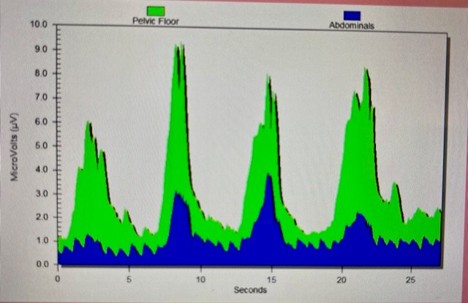 Excessive pelvic floor activity during attempts at bowel evacuation creates a mechanical barrier to evacuation and demonstrates dyssynergia (incoordination). When a patient “bears down” the abdominals (blue) should increase, and the pelvic floor (green) should relax.
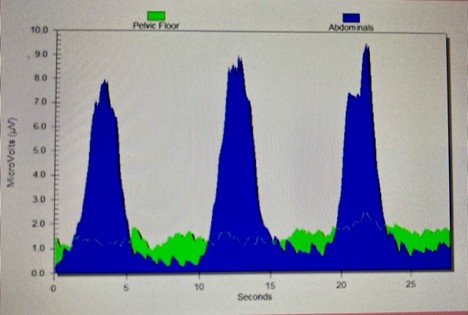 Excessive pelvic floor activity during attempts at bowel evacuation creates a mechanical barrier to evacuation and demonstrates dyssynergia (incoordination). When a patient “bears down” the abdominals (blue) should increase, and the pelvic floor (green) should relax.